Sunscreen has always had one obvious job: stopping ultraviolet (UV) rays before they reach the skin. Yet what if UV rays could be captured and turned into light that actually does the skin some good, rather than simply being blocked?
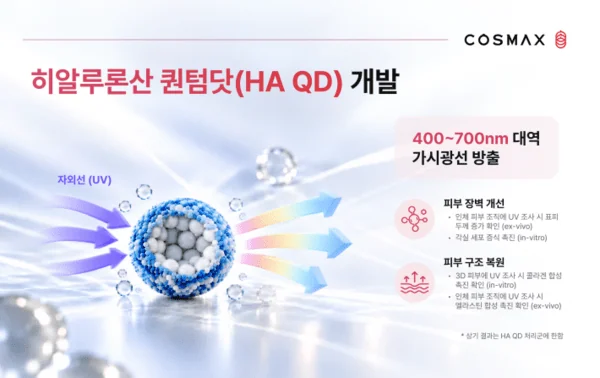
That question is the starting point of the hyaluronic acid quantum dot (HA QD), a new sun care ingredient from COSMAX, a cosmetics ODM (research, development and manufacturing) company. HA QD applies to cosmetics a defining trait of quantum dots: they take in light and release it at another wavelength. If it reaches the market, it could pave the way for sunscreens designed to protect against UV and care for the skin in a single step.
COSMAX said on the 22nd that it had developed HA QD, a quantum dot built on hyaluronic acid, together with the research team of Professor Lee Young-chul at Gachon University, and had filed patent applications both in Korea and overseas.
A ‘natural quantum dot’ hidden in hyaluronic acid, the go-to moisturizing ingredient
A quantum dot is an ultrafine particle just a few nanometers (nm) across, tens of thousands of times thinner than a strand of hair. It absorbs light and gives it off again at a particular wavelength, in other words a particular color. In its search for new sun care materials, COSMAX began looking at light-active materials made from natural polymers. The researchers reasoned that if a natural substance could absorb and emit light, hyaluronic acid might be a promising choice. Widely known for its moisturizing effect, hyaluronic acid occurs naturally in the skin and has a long track record as a cosmetic ingredient.
Through joint research with Professor Lee’s team, COSMAX managed to reproduce the light-converting behavior of quantum dots with hyaluronic acid and without any heavy metals. The achievement suggests that quantum dots, until now used largely in electronic materials such as displays, could find a place in cosmetic ingredients.
Taking in UV and giving back light that helps the skin
What sets HA QD apart most clearly is that it goes beyond absorbing UV rays: it shifts their wavelength and releases them again. Standard UV absorbers lose most of the absorbed energy as heat, while HA QD transforms part of it into light at 400 nm or longer and directs it back to the skin. Light in this range has been linked to antibacterial effects and to stimulating collagen production by fibroblasts.
More collagen expression in a 3D skin model, with new products planned for next year
Efficacy tests carried out by COSMAX itself also point to skin benefits. When a three-dimensional (3D) skin model was treated with HA QD and then exposed to UV light, researchers saw higher collagen expression along with changes in the epidermis. These findings suggest the ingredient could be used in sunscreens aimed at improving skin elasticity and barrier function. COSMAX intends to confirm the effects in a human application test later this year and to include HA QD in new products scheduled for release next year.
About 25 nm particles mean less white cast and a stable formula
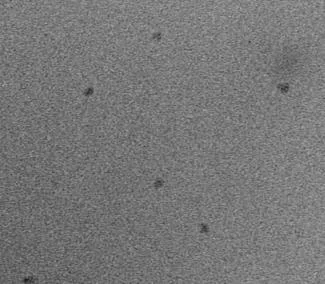
HA QD also performs well on feel and formula stability. Because its particles measure only about 25 nm, it can cut down the white cast that sunscreen often leaves on the skin. No clumping was seen during use in COSMAX’s formulation trials. The company added that a three-month accelerated stability test at both high and low temperatures showed no separation, settling or aggregation.
Over 99% cell viability, and a PCT application aimed at global markets
Since it is made from hyaluronic acid, the ingredient is also regarded as safe. Cytotoxicity tests on human keratinocytes and fibroblasts showed cell viability of more than 99% at concentrations as high as 400 μg/mL. COSMAX plans additional toxicity studies, including skin irritation tests.
The patents COSMAX has filed cover the ingredient itself as well as how it is made and how it is used in cosmetics, and the company has also completed an international filing under the Patent Cooperation Treaty (PCT). Building on this, it is getting ready to enter key markets such as the U.S., Europe and China.
“Quantum dots were once seen as having nothing to do with cosmetics, but a change of perspective has turned them into a sun care ingredient,” said Yoon Seok-kyun, Lab Head at COSMAX BTI R&I. “We will usher in a new era in which UV rays are not merely blocked or absorbed but transformed into light that is good for the skin.”
Questions and answers
What is HA QD, the hyaluronic acid quantum dot?
HA QD is a new sun care ingredient developed jointly by COSMAX and the research team of Professor Lee Young-chul at Gachon University. Made from the moisturizing ingredient hyaluronic acid, it is a natural quantum dot that takes in light and releases it at a different wavelength, with no heavy metals involved.
In what way is HA QD different from standard UV absorbers?
Standard UV absorbers lose most of the energy they take in as heat. HA QD instead turns part of that energy into light at 400 nm or longer and directs it back to the skin, a range of light linked to antibacterial effects and to stimulating collagen production by fibroblasts.
What do the efficacy and safety tests on HA QD show?
In a 3D skin model treated with HA QD and then exposed to UV, collagen expression rose and the epidermis changed. Cytotoxicity tests on human keratinocytes and fibroblasts found cell viability above 99% at concentrations up to 400 μg/mL. More toxicity studies, such as skin irritation tests, are planned.
When can consumers expect products made with HA QD?
COSMAX aims to confirm the effects in a human application test this year and to use HA QD in new products scheduled for next year. Patent applications have been filed in Korea and abroad, including a PCT international application, and the company is preparing to expand into the U.S., Europe and China.