
A diagnosis that calls for surgery usually sends people looking toward large university hospitals first. Lately, though, community hospitals have been deepening their expertise and taking on complex operations, supported by seasoned medical teams and well-organized care systems.
Health Kyunghyang’s “Spotlight Hospital” series highlights the work and strengths of these community hospitals and offers practical information to help readers make good use of the medical care they need close to where they live.
Wellton Hospital is a specialty joint hospital with deep clinical experience, particularly in hip and knee replacement. Under Director Song Sang-ho’s surgical philosophy of “a life walking on two feet again,” it has built up patient-specific surgery, digital technology and an organized rehabilitation system. <Editor’s note>
As people live longer, remaining socially active and independent in old age has taken on greater importance, and the aims of joint disease treatment are shifting as a result. Easing pain and getting through surgery successfully are no longer the whole story; how soon patients can walk again and resume normal life has become a central concern.
Hip fractures are a case in point: what happens after surgery matters as much as operating quickly. Older patients who stay immobile for long periods after surgery face a higher risk of complications such as pneumonia, blood clots and muscle loss, and their chances of survival may even be affected. Knee replacement, likewise, has to aim beyond pain relief toward steady walking and a return to daily activities.
Against this backdrop, Wellton Hospital has spent many years building hip and knee replacement and related joint care into its specialty under the treatment philosophy of “a life walking on two feet again,” amassing considerable clinical experience and know-how along the way.
Director Song Sang-ho is the driving force behind this work. In his view, how quickly a patient walks again is just as important as a successful operation. Following that philosophy, Wellton Hospital chooses artificial joints that match each patient’s bone condition and operates in a way that spares as much muscle and tendon as possible.
One of its core surgical principles is to get not only leg length right but also offset, which influences how the muscles around the hip function, along with joint stability. Combining this with digital technology and early rehabilitation, the hospital has created a treatment pathway that carries patients from the operating room back to their everyday lives.
The numbers are impressive. On September 29, Dr. Song passed the milestone of 8,000 hip replacements performed as sole operating surgeon, and he has also built up experience across 7,700 knee replacements.

Bone cement plus muscle- and tendon-sparing surgery preserve the strength to walk
For older people who have broken a hip, getting up and moving safely as soon as possible after surgery is vital, both to avoid the complications of lying in bed for long periods and to regain the ability to walk.
With that in mind, Wellton Hospital makes active use of cemented fixation, which secures the artificial joint with bone cement, for older patients whose bones are weak. Cemented fixation helps provide stability right after the operation, making it an important option when early walking is the priority for older patients. It is not used for everyone, however; the surgical approach is chosen based on age, bone quality and overall health.
Sparing muscles and tendons is another pillar of treatment at Wellton Hospital. The muscles and tendons around the hip are essential for holding the joint steady and for walking. During surgery, the hospital keeps damage to these tissues to a minimum so that patients retain as much of their natural muscle function as possible. This is about more than a smaller incision; it is about protecting the physical foundation patients need to walk again after surgery.
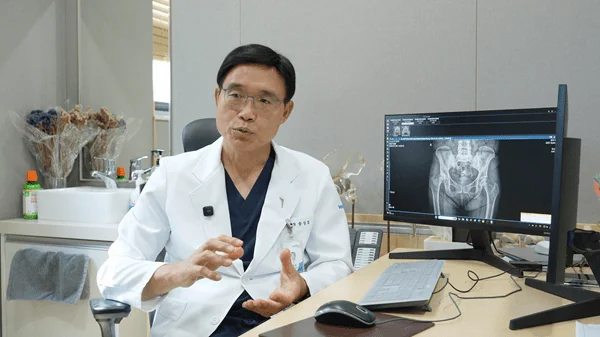
“Equal leg length is only part of the job”: precision surgery that gets offset right too
At Wellton Hospital, a hip replacement does not stop at selecting an appropriate implant. Leg length, offset and joint stability are weighed together, with the aim of restoring as much of the patient’s natural hip function as possible.
Dr. Song points to offset restoration as one of the most demanding yet indispensable parts of hip surgery. Offset is the distance between the center of the femoral head and the central axis of the femoral shaft, essentially a measure of the hip’s side-to-side balance, and it strongly influences how the surrounding muscles produce force.
When offset is too small, the muscles lose leverage, and patients may limp or walk unsteadily even with legs of equal length. When it is too large, the muscles and tendons are put under tension, which can bring pain or limit movement.
“The goal is not to make the offset as big as we can but to restore it in line with each patient’s anatomy,” Dr. Song said. “That is what allows the surrounding muscles to work as they should and lets the patient walk more naturally and steadily.”
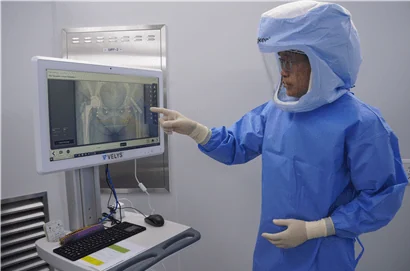
Wellton Hospital relies on computer-assisted surgical navigation to put these principles into practice. Imaging before surgery is used to assess the patient’s bones and joints and set targets for leg length and offset, and during the operation the position and angle of the implant are confirmed in numbers.
Since muscle- and tendon-sparing surgery works through a smaller incision, the surgeon’s field of view can be restricted, and digital navigation helps make up for that.
“Joint replacement is not just a matter of fitting components together neatly,” Dr. Song stressed once more. “Leg length, offset and joint stability all have to be considered as a whole.”
Treating every step, from picking the right stem for the patient to restoring leg length and offset and confirming joint stability, as one continuous process lies at the heart of the personalized hip surgery Wellton Hospital practices.
8,000 hip operations and steady results in HIRA’s analysis-based review
Objective measures also bear out the surgical experience and treatment results the hospital has built over the years.
According to the Health Insurance Review and Assessment Service (HIRA) analysis-based review of hip arthroplasty for the second quarter of 2026, published in August, none of the 81 patients analyzed experienced a dislocation within three months of surgery or needed another operation within three months of discharge. Hospitals in the same category averaged a 1.3% dislocation rate and a 2.1% reoperation rate over that period. Only 9.9% of the hospital’s surgical patients needed a blood transfusion, compared with a category average of 61.8%. In addition, the hospital posted a 0% dislocation rate in 10 of the 12 quarters between the third quarter of 2023 and the second quarter of 2026.
These figures are among the objective signs of the surgical experience and treatment results Wellton Hospital has built up.

Rehabilitation starting four hours after surgery, with stationary cycling to rebuild muscle function
Wellton Hospital treats the journey back to walking as a core part of care.
Its signature program is the “1-4-5 Recovery System.” An operation of about one hour keeps tissue damage to a minimum, patients take their first steps and begin rehabilitation roughly four hours afterward, and the target is independent walking without crutches by the fifth day.
Stationary cycling features prominently in rehabilitation. Riding a stationary bike lets the hip and knee move through repeated cycles while the load on the joints is kept under control.
“Pedaling engages several muscles around the hip at once, which supports muscle coordination and functional recovery,” Dr. Song explained. “With Wattbikes, we analyze the strength balance between the two legs, power output and cadence, and we tailor rehabilitation programs to where each patient is in their recovery.”
7,700 knee replacements, with robotic assistance for extra precision
The expertise Wellton Hospital has developed through hip surgery extends to knee replacement as well.
Dr. Song has now performed more than 7,700 knee replacements in total and uses a robotic-assisted surgical system to make operations more accurate.
In a knee replacement, the damaged joint surfaces are removed and an artificial joint is put in their place, which calls for careful attention to the alignment of the lower limb, the balance of the ligaments and where the implant sits. Robotic-assisted surgery draws on data gathered during the operation to check the extent of bone cuts and the implant position, helping the surgical plan be carried out precisely.
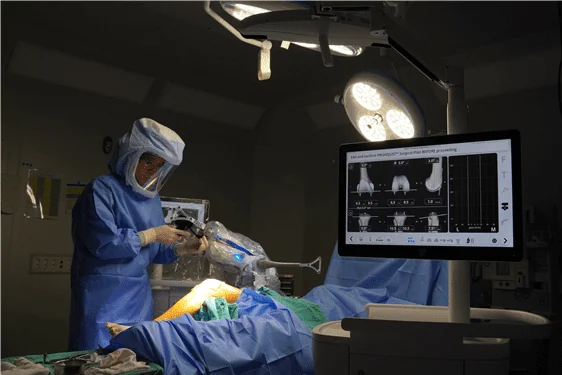
Here, too, Wellton Hospital looks beyond surgical accuracy to helping patients walk steadily and keep living independently.
“Whether it is a hip or a knee, recovery after surgery matters as much as operating precisely,” Dr. Song said. “By tying together patient-specific surgery, digital technology and early rehabilitation even more closely, we will keep improving our treatment system so patients can return to everyday life sooner and more securely.”
Wellton Hospital has turned Dr. Song’s surgical philosophy into a treatment system shared across the entire hospital. With one consistent approach from surgery through rehabilitation, it helps patients toward a “life of walking again.”
Questions and answers
What kind of hospital is Wellton Hospital?
Wellton Hospital is a specialty joint hospital centered on hip and knee replacement. On September 29, Director Song Sang-ho reached 8,000 hip replacements as sole operating surgeon, and he has carried out 7,700 knee replacements in total.
What role does offset play in hip replacement?
Offset is the distance between the center of the femoral head and the central axis of the femoral shaft, and it affects how the hip muscles produce force. If it is too small, patients may limp even with legs of equal length; if it is too large, pain or limited movement can follow. It should therefore be restored to match each patient’s anatomy.
What do objective figures say about Wellton Hospital’s hip surgery results?
In HIRA’s Q2 2026 analysis-based review of hip arthroplasty, none of the 81 patients analyzed had a dislocation or reoperation within three months, versus category averages of 1.3% and 2.1%. The transfusion rate was 9.9%, well below the category average of 61.8%.
How does the 1-4-5 Recovery System work?
It is Wellton Hospital’s early rehabilitation program. An operation of about one hour limits tissue damage, patients take their first steps and start rehabilitation about four hours later, and the goal is to walk unaided without crutches by day five.