

A famous Roman dictator, Julius Caesar also could not avoid hair loss even though his name means “with rich hair (Caesar)”. We could find records that his former partner, Cleopatra, had used numerous methods to treat his hair loss.
Hair loss can be largely divided into 'falling out' and 'thinning,' but in general, more than 90% of so called “hair loss” is regarded as “baldness” or “androgenetic alopecia,” the condition that leads to thinning hair but not falling out. The standard treatments so far are oral medicines (finasteride, dutasteride), topical medicines (minoxidil, alfatriol), and autologous hair transplantation.
However, a medical device also has been trying to expand on this market. It had been introduced as one of the next-generation inventions by the Times magazine in 2000 and was approved by the US FDA as the world’s first hair loss treating medical device and launched with the name “Hair Max” in 2007. In the early days of the market, most doctors who majored in hair loss treatment were skeptical about the effect, saying the product was a "nonsense." In general, the presentation of basic mechanism or explainable theory, although not exact, to support the study should be provided beforehand in addition to clinical efficacy. But this product was completely doubtful even when looking at the before and after photos, and there were no published well-designed studies and no scientific evidence to explain the effect, so the majority of the doctors said the US FDA's approval was limited to safety, not its efficacy.
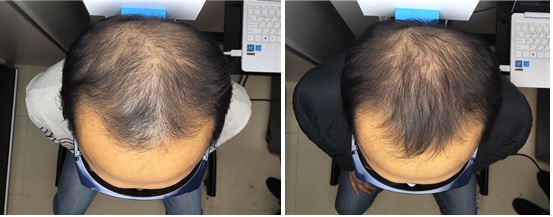
In this situation, Wontech, a South Korean company, began developing a hair loss treatment laser device. I have conducted a six months clinical trial with a total of 40 patients including a control group from 2009 to 2010. As a result of the treatment with this laser, the average number of hair increased by 17.2/㎠ and the average hair thickness increased by 12.6㎛. This was the first research case in the world that proved efficacy by scientific comparative study, and through this, it was honored to be published in the SCI journal for the first time, also being the first domestic laser approved by the Ministry of Food and Drug Safety (MDFS) for hair loss treatment. Since then, several researchers have continuously published clinical studies, and as a result, recent medical academic guidance has approved the effectiveness of the hair loss treatment laser.
This year, I also was involved in developing a brand-new hair loss treatment laser customized to the type of hair loss through joint research of cell and animal experiments with LG Electronics. Also, I have co-developed imaging equipment to evaluate them and conducted clinical research. Consequently, the laser obtained approval from the MDFS in early September this year. This device is expected to be useful especially when it is difficult to apply existing treatment methods or if additional effects are desired with existing treatments.
When choosing a laser for hair loss treatment, what to remember is whether it has passed a clinical trial and received MFDS approval. This can simply be done by checking whether there is a phrase “medical device.” More accurate information can be found through the product information section on the “electronic complaint counter for medical devices” on the MFDS website. The laser for hair loss treatment is only approved for the androgenetic alopecia treatment and is not effective for other types of hair loss such as alopecia areata.
![[Card News] Better Together Seoul Culture & Wellness Festival...See you on October 9 at DDP Oullim Square!](/news-images/85341c44f72401a7415c4da5ca3242f3434fe2a10935287f5b87d7acbd88ad87-480-v1.webp)