With the aging of the population, public interest in dental implants has increased. However, so many myths make us more confused about identifying reliable information. In addition, the highly competitive marketing can only make patients even more perplexed. Health Kyunghyang is launching a new 'Healthy Implant Campaign' to fulfill its role as Korea's representative health newspaper. We will provide a credible source to help readers on their healthy implant journey through interviews with experts. The first interviewee is Myeong-Jin Jeong, director of Guardians Dental Clinic. < Editor's Note
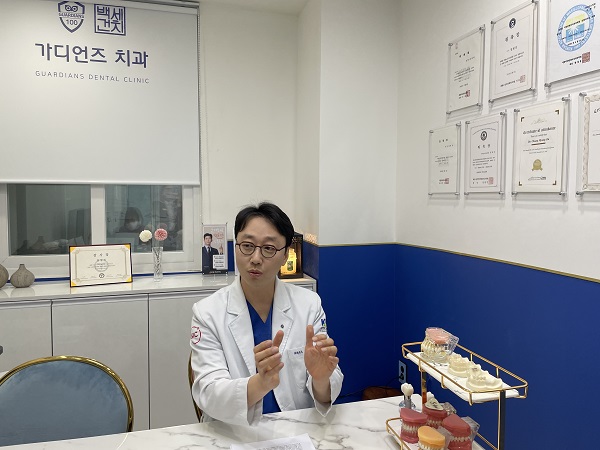
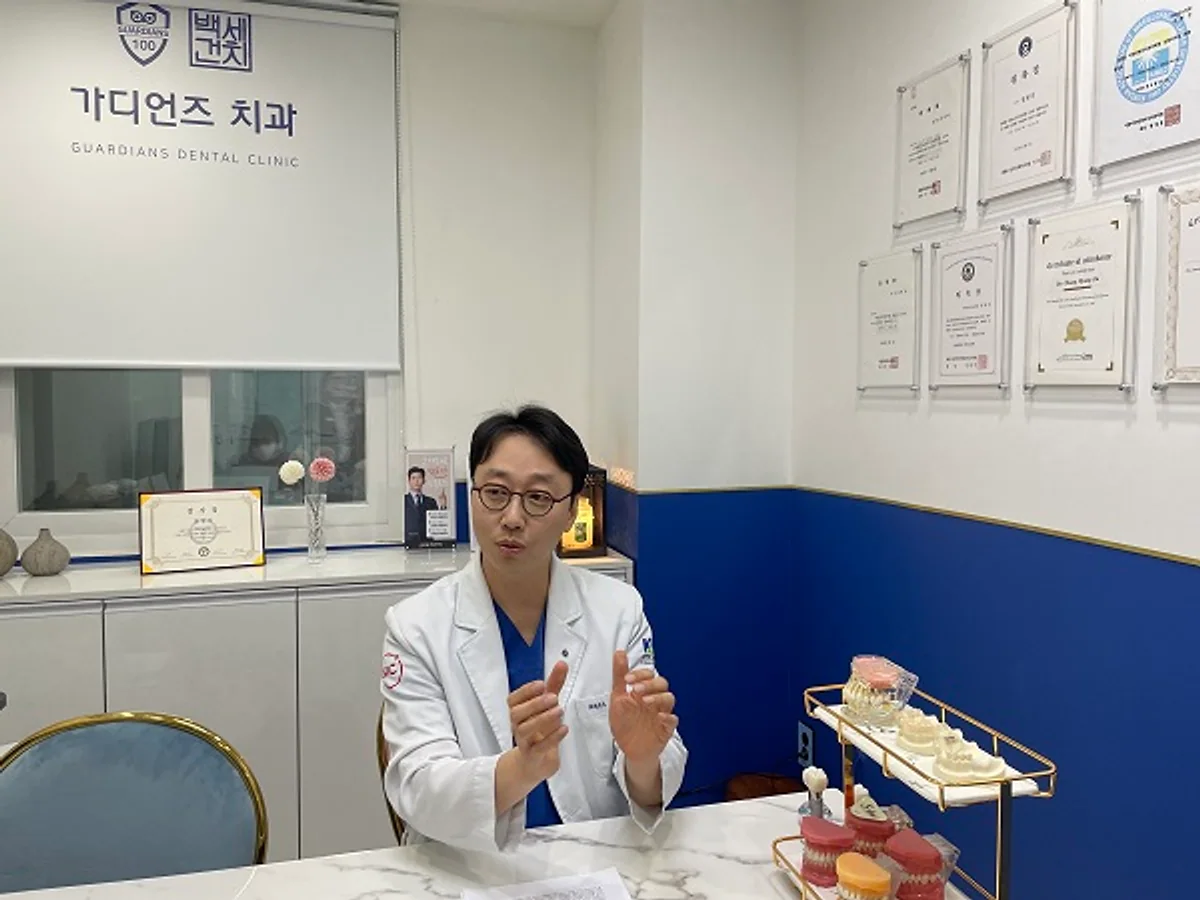
Implants are of great comfort to patients who have lost teeth. However, successful implants must be accompanied by optimal product selection and careful follow-up management. I interviewed Myeong-Jin Jeong, the CEO of Guardians Dental Clinic, for more details.
-Would you explain what dental implants are and the procedures?
Implants insert autologous tissue or artificial replacement into a living body to restore a defective part of living tissue, and it is often referred to as dental implants. Dental implants refer to inserting a screw-type fixture into the alveolar bone to replace the lost natural tooth and perform the prosthetic treatment.
Not all of these processes are carried out in one day. Practitioners must wait until the implant attaches nicely to the bone before positioning it on the upper prosthesis, usually taking 8 to 10 weeks. If the bone graft is performed due to insufficient gum bone, it takes up to 4-5 months more.
-As an expert, what would you advise for the patients: Dentures or Dental Implants?
If possible, dental implants are recommended. However, many patients with the alveolar bone condition, systemic disease, or other reasons are not eligible for dental implants. The so-called implant-retained dentures, which use both implant and denture, can be considered a suboptimal solution. Of course, there are cases in which only dentures should be used, depending on the circumstances. Therefore, I advise that you select a treatment method suitable for your health state and alveolar bone shape after sufficient consultation with a specialist.
-Are there any side effects of dental implants with Titanium?
Titanium is a representative pro-biological metal currently used in the medical field. However, when it is used, purity should be carefully inspected. The purity of titanium that can be operated in the human body is set internationally. It is classified from Grade 1 with the highest purity to Grade 5, an alloy. And among them, Grade 4 is used for dental implants. Recently, there have been many cases of using Grade 5 with alloy added to increase strength.
However, the effect of the alloy on the human body is still questionable. As a result, famous implant companies in Switzerland and Germany focus on producing implants with a pure surface, away from alloys. I am currently using a Swiss SIC implant with good surface treatment and acquired good outcomes in elderly patients and patients with systemic diseases.
-What are the specific advantages of implants with fine surface treatment?
Suppose the implant surface is contaminated or embedded with harmful materials. In that case, the bone may contact foreign materials other than titanium, which may interfere with osseointegration or cause infection. Therefore, it is much more secure for patients with systemic diseases or patients vulnerable to infection, such as the elderly, to choose an implant with a smooth surface. The existing SIC implant has an uninfected surface even with an electron microscope.
-What are other benefits that the implant provides to patients?
In general, implant products are in the form that a cone-shaped screw wound in. In other words, since it has an inclined angular surface, the angle may change over time, or the implant may be pushed. However, the SIC implant currently in use does not cause the implant to be pushed or turned off, so parallel surfaces are in contact.
Then, the prosthesis can also attach more stably. If the implant is pushed, bacteria are more likely to penetrate through it, or the screw may come loose. This risk can also be reduced.
-When the marketing competition for dental implants is intense, patients often suffer a loss. What are the criteria for choosing implant products patients should consider in advance?
Implants distributed in Korea are products that have passed the strict standards of the Ministry of Food and Drug Safety, both domestic and foreign. In particular, the products produced by domestic manufacturers are outstanding, and they are already exported to the world market. They are reliable and safe.
However, European products have accumulated data, clinical experience, and many studies throughout a long history. Among them, SIC Implant has studied the design, surface treatment, and treatment procedure through meetings of implant experts led by Dr. Shiley, the founder. Many universities and clinicians are currently contemplating and researching to improve the safety and quality of SIC implants.
-Please explain the hospital's efforts for noncontroversial and successful implants.
Above all, we perform pre-simulation using a computer for accurate surgery and plan the implant placement location and angle. Furthermore, we design a digital guide suitable for the plan in the hospital's laboratory. As the operation proceeds as planned according to the digital guide, the operation time can be shortened, and the patient's pain and discomfort can be relieved. In addition, side effects can be minimized in patients with insufficient alveolar bone or anatomical risk.
Various dental implants are available for the patient to choose from for the optimal outcome. We use both domestic and overseas good implant products, and we select the most suitable product in consideration of the patient's alveolar bone condition and systemic disease.
-Post dental implant care instructions are also fundamental. Would you explain it more?
Unlike natural teeth, dental implants do not have periodontal ligaments that act as a protective film, so once inflammation occurs, it can progress rapidly. Therefore, it is necessary to pay more attention to the care of the surrounding gums. It is essential to check the condition of the gums through regular medical check-ups and to use the correct oral products to manage oral hygiene thoroughly.
Also, many people complain of discomfort due to food getting stuck, but dental implants have that structure. The implants are fixed to the bone, but the surrounding regular teeth move with specific mobility, so food can easily get caught between the gaps. Therefore, it is necessary to thoroughly remove food by using not only a toothbrush but also an interdental brush and dental floss.
It is crucial to choose an oral product that is appropriate for you. In particular, if there is no major problem with the gums or if the inflammation has subsided, it is more beneficial to use a hard toothbrush rather than a soft toothbrush. Just as dust on a rough surface can be removed by sweeping with a broom with a coarse grain, too soft bristles do not have the strength to clean it effectively. If you have a problem using an interdental toothbrush or dental floss, you can consider using a water pick that shoots water.
-Should patients go to the hospital instantly when the dental implant feels loose?
Yes, they should visit their dentists as soon as possible to resolve the cause. Most of the time, it is because the screws of the fixed body implanted in the bone and the upper connection part are loose. As long as you tighten the screws again, there is no problem. However, if peri-implantitis cause the entire implant loose, surgery must be performed after removing the implant. In addition, if the upper prosthesis is missing or the screw is damaged, even the placed implant may be impaired. Therefore, patients should visit a hospital and get professional treatment regardless of the regular treatment date if the implant feels loose or moving.
Dr. Myungjin Jung;’s essential tips on your dental implants.
1. Through expert treatment, determine whether implants are appropriate for you.
2. Considering systemic disease and alveolar bone condition, select the optimal product.
3. Thoroughly manage implants with oral products that are right for you.
4. If the dental implants feel loose or moving, go to the hospital immediately.
![[Card News] Better Together Seoul Culture & Wellness Festival...See you on October 9 at DDP Oullim Square!](/news-images/85341c44f72401a7415c4da5ca3242f3434fe2a10935287f5b87d7acbd88ad87-480-v1.webp)