Upon reflection, I realized how challenging it must have been for my grandmother, who had severely decayed teeth and had to repeatedly remove and insert dentures due to the lack of remaining teeth. I now understand why her meals consisted mainly of soft dishes.
"Oh my, to receive dental treatment, I had to close my shop for a day and travel to Jecheon."
These were the words of Jeong Yumin (pseudonym), my grandmother, who lived in Danyang, Chungcheongbuk-do, for 68 years. I recalled my late grandmother. To think she had to travel for an hour just for dental treatment... Yet, she managed to maintain her health.
However, like Jeong Yumin, most elderly individuals in our area had poor oral health, possibly due to being in a medically underserved area.
"What if you were elderly and there were no dentists to visit?"
Danyang, Chungcheongbuk-do, with a population of only 27,000, is considered a region facing population decline and medical vulnerability. With the elderly population aged 65 and over accounting for 36.3%, it has already become an ultra-aging society. While basic medical facilities exist, accessing advanced services such as precise examinations or implants requires traveling about an hour to Jecheon for treatment.
AIoBIO, participating in the Visiting Bus program, conducted oral health examinations for the elderly using Qray technology.
■ Nonghyup Central Federation and the Ministry of Agriculture, Food and Rural Affairs Implement the Mobile Rural Healthcare "Visiting Bus" Program
According to the National Health Insurance statistics, healthcare expenses for individuals aged 65 and above surpassed 44 trillion won. According to the significant health insurance statistics released by the National Health Insurance Service for 2022, the total medical expenses amounted to 102.4 trillion won, of which 44.1 trillion won, accounting for 43.15%, was utilized by the elderly population aged 65 and above.
As South Korea is expected to transition into a super-aged society by 2025, preparations are necessary. Specifically, reducing medical expenses through preventive measures is imperative.
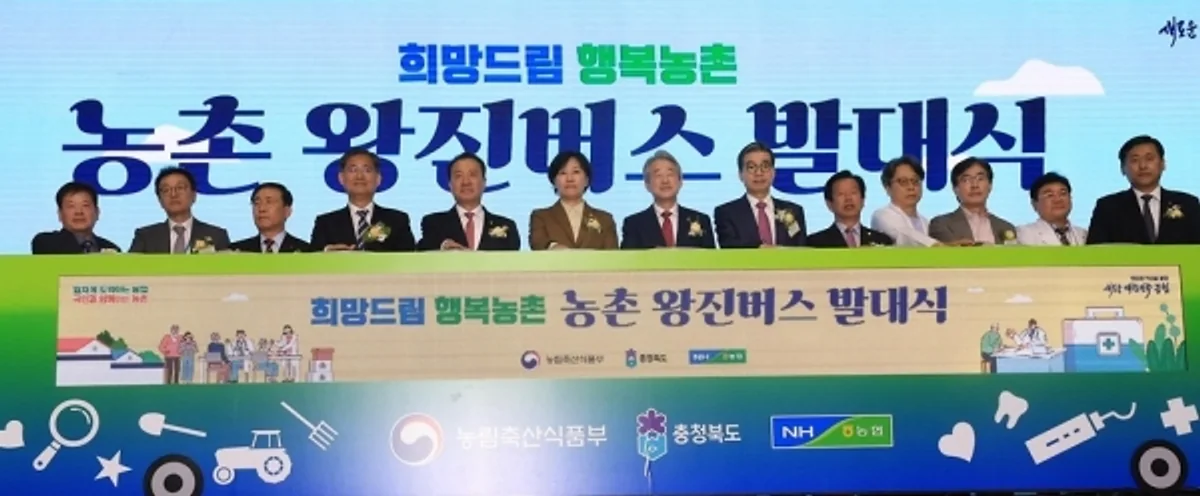
In response, the Nonghyup Central Federation and the Ministry of Agriculture, Food and Rural Affairs held the inauguration ceremony for the "2024 Rural Healthcare Visiting Bus" on April 19th at Mapo Gymnasium in Danyang-gun, Chungcheongbuk-do.
The Rural Healthcare Visiting Bus project aims to provide comprehensive medical services, including traditional Korean medicine, oral health examinations, and checkups, to residents of rural areas with limited access to medical facilities such as clinics and pharmacies. The plan for 2024 is to operate the bus approximately 300 times annually, targeting rural and depopulated areas.
The inaugural event for the first Visiting Bus of the year was attended by Minister of Agriculture, Food and Rural Affairs Song Mi-ryeong, Nonghyup Central Federation Chairman Kang Ho-dong, Member of Parliament Eom Tae-young from Jecheon-Danyang, and Chungcheongbuk-do Vice Governor Jeong Seon-yong. Over 50 medical professionals from various fields, including traditional Korean medicine (Sangji University Hospital), dentistry (Open Doctors Society), integrated medical services (Healthcare Volunteer Society), oral health examinations (AIoBIO), and checkups (The Story), provided medical services to around 300 elderly residents and farmers residing in Danyang-gun.
Minister Song Mi-ryeong stated, "The Rural Healthcare Visiting Bus project will contribute to improving the quality of life for residents in rural areas facing population decline and revitalizing vibrant rural communities," and expressed her commitment to strengthening collaboration with relevant ministries to enhance the medical environment for rural residents in the future.
■ Elderly Oral Health Examination Rate at 18.5%... Economic Burden
The booth was bustling with activity. There was no feast, but one spot that caught the reporter's attention was the "oral health examination."
As people age, it's natural for their bodies to experience ailments. Particularly, when it comes to teeth, they significantly impact eating and speaking, thus accelerating the aging process.
However, elderly individuals often don't visit the dentist. According to the "Social Security in Statistics 2018" by the Korea Institute for Health and Social Affairs, only 18.5% of those aged 65 and above received oral health examinations, compared to 68.9% for general health checkups and 45.7% for cancer screenings.
Even the grandparents participating in the "Visiting Bus" rarely underwent oral examinations. Some were even unfamiliar with dental scaling. They lamented that the most regrettable aspect was the economic burden of needing dentures or implants after a single dental visit, causing significant financial strain. Consequently, many elderly individuals postpone dental visits to avoid burdening their children.
However, teeth don't naturally regenerate. Therefore, regular brushing and dental care are essential for managing tartar buildup. Yet, many elderly individuals are unaware of where tartar forms in their mouths.
Kim Jung-hee, a dental hygienist participating in the rural Visiting Bus initiative, remarked, "Many adults avoid dental visits to avoid financial burden on their children," adding, "This oral health examination and prevention education were significant, as there were people who had never brushed their tongues or used dental floss in their lifetime."
After undergoing oral health examinations, the grandmothers and grandfathers participating in the Visiting Bus listen to explanations about dental care methods.
■ AIOBIO continues its consistent efforts in promoting oral health.
"Smile, please!" A blue light flashed, followed by red fluorescent lights appearing on the adjacent monitor. AIOBIO, participating in the rural welfare bus program, conducted oral health screenings for older people using a medical device called 'Qray.'
This isn't AIOBIO's first venture into oral health promotion. Last year, through the 'Happy Farmer Bus' program, they provided oral health management assistance to over 2,200 farmers across 13 locations nationwide.
The Qray by AIOBIO utilizes a fluorescence imaging system. It uses blue visible light to reveal dental decay and cracked teeth as red fluorescence. This technology allows for the clear identification of invisible oral conditions and is currently utilized in dental clinics under health insurance coverage.
Mr. Lee Heung-seob (pseudonym), 77, expressed surprise, saying, "No one ever told me I had to brush my tongue. Even though I brushed before coming, I was shocked to see so many red areas." He added, "Not only did I receive the examination, but I also learned personalized dental care methods, so I'll pay more attention to brushing when I get home."
Some elderly participants marveled at the novelty. Unlike traditional oral health screenings conducted with the patient reclined while the dentist explains, Qray allows for an immediate overview of problem areas.
After receiving oral health screenings with Qray, participants were educated on dental care methods, including brushing techniques, tongue cleaning, and flossing, all of which can be managed at home.
Yoon Hong-cheol, CEO of AIOBIO, emphasized the importance of prevention not only for diseases like cancer, diabetes, and gout but also for dental health. He explained, "The most crucial aspect of dental treatment is preserving natural teeth because once a tooth is damaged, recovery is nearly impossible, making prevention essential." He added, "To enhance oral health promotion for vulnerable populations and local communities, we've introduced Qray and LinkDent features in this rural welfare bus project, strengthening our commitment to social contribution."
![[Card News] Better Together Seoul Culture & Wellness Festival...See you on October 9 at DDP Oullim Square!](/news-images/85341c44f72401a7415c4da5ca3242f3434fe2a10935287f5b87d7acbd88ad87-480-v1.webp)