Cosmetics manufacturer Kolmar Korea wants to know how a product will behave on the skin before it ever produces a sample. The company is developing artificial intelligence (AI) that can forecast skin reactions and ingredient absorption using nothing more than formulation data, a step designed to make product development more efficient.
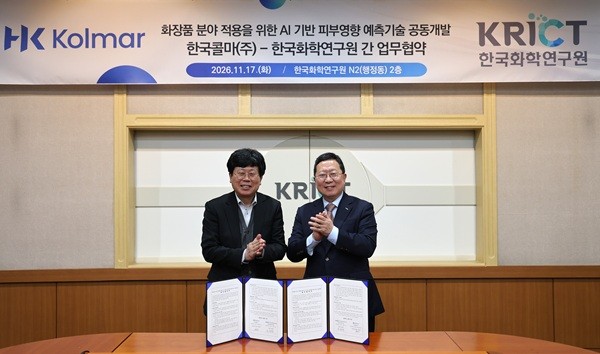
On Nov. 17, Kolmar Korea signed a memorandum of understanding (MOU) with the Korea Research Institute of Chemical Technology (KRICT) to develop AI-based technology for predicting effects on the skin. Moon Byoung-seok, head of the Kolmar Holdings technology research institute, and KRICT President Shin Seok-min were among the officials at the signing.
The partnership covers three areas: joint research and technology exchange on AI-driven skin impact prediction, assessment of the technology's validity and performance, and real-world testing and validation of prediction models built on representative ingredients and formulas.
From single ingredients to the full formula
What sets the project apart is its scope. Rather than stopping at individual ingredients, the planned AI model is meant to predict skin reactions and absorption for an entire formula in which many raw materials are blended together.
If it works as intended, developers could estimate a product's possible effects on the skin and how well its ingredients are absorbed from the ingredient mix alone, without first making a prototype.
An early check on heavily regulated ingredients
The partners also want formulas containing ingredients that face demanding rules in different countries, including organic UV absorbers, preservatives and surfactants, to be screened while they are still being designed.
KRICT will build the model, drawing on its existing AI tools for predicting the toxicity of single substances and mixtures. Kolmar Korea will test whether the technology can be commercialized by applying it to real cosmetic ingredient and product information.
Faster, cheaper development and global compliance
Kolmar Korea intends to bring the finished technology into its own R&D workflow. Checking and adjusting formulas at the design stage should save time and money, the company said, and help it keep pace with cosmetic safety regulations worldwide.
"With this agreement, we now have a foundation for verifying skin safety right from the start of product development," a Kolmar Korea official said, adding that the company will create K-beauty products trusted by consumers worldwide and actively help its clients grow in overseas markets.
Questions and answers
Why did Kolmar Korea and KRICT sign the agreement?
To jointly build AI technology that predicts, in advance, how cosmetics will affect the skin and how well their ingredients are absorbed. The aim is a model that can assess skin safety at the very beginning of product development.
How is this AI approach different?
It looks at the full formula, not just one ingredient at a time. Once ready, it is expected to estimate skin effects and ingredient absorption from formulation data before any prototype exists.
What could change if the technology reaches the market?
Formulas could be reviewed and fine-tuned early, which may shorten development and lower costs. It could also help companies screen formulas containing ingredients that are tightly regulated in specific countries before entering global markets. Its real-world accuracy and commercial value, however, still have to be proven.