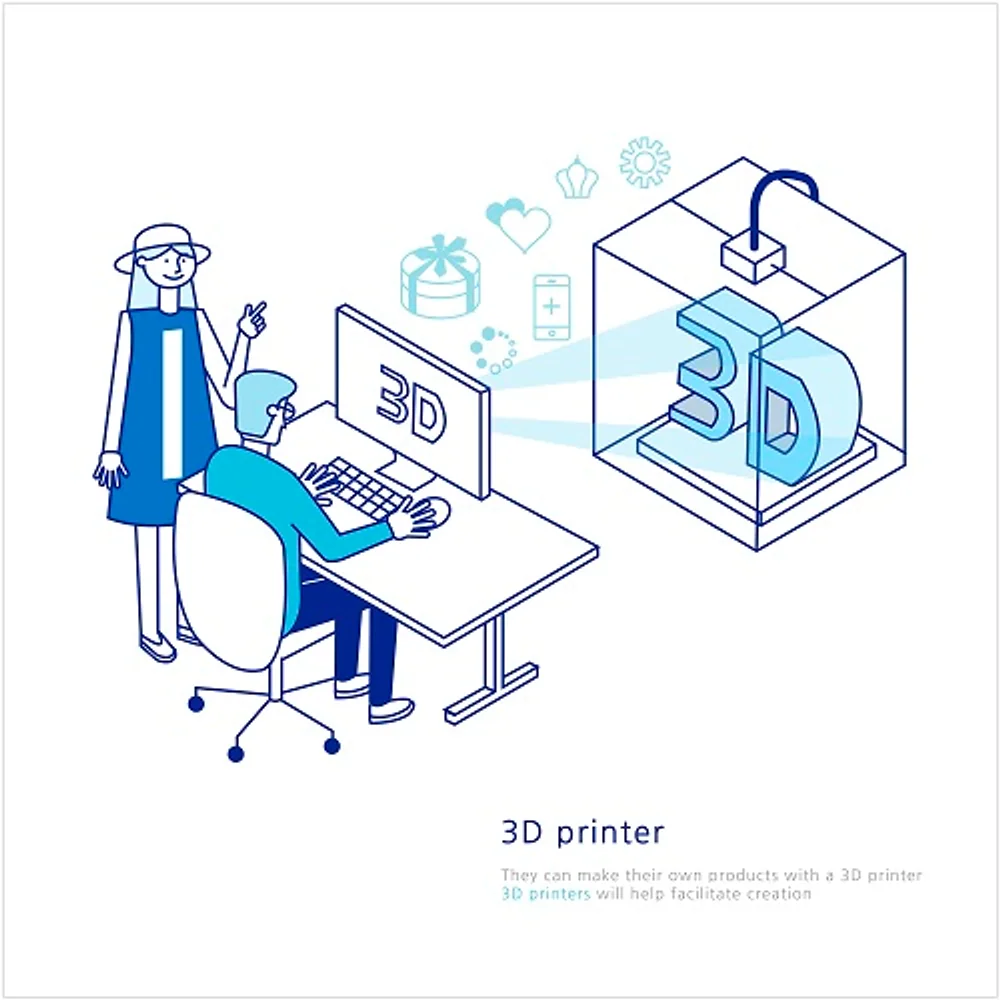
3D printing is a technology to manufacture three-dimensional objects by utilizing additive manufacturing methods, breaking away from conventional milling, cutting, and assembling.
Recently, with the 3D printing materials that have been diversified, the technology has progressed significantly and actively introduced into the medical field, such as 'customized medical implants' and 'virtual simulation.'
The customized 3D printing technology is most actively employed for hearing aids, implants, prosthetic legs, and prosthetic limbs.
In the case of hearing aids, in the past, engineers had to cut and trim them one by one, which necessitated a lot of time and money.
However, with a 3D scanner and printer applied, a hearing aid can be manufactured after modeling the ear's precise shape with silicone.
Lately, it has become achievable that even 'customized artificial bones' are manufactured, granting hope for osteosarcoma (bone cancer) patients.
By using 3D printing technology, in 2018, Chung-Ang University Hospital presented an artificial breast bone measuring 28.6 cm in width, 17.2 cm in length, and 190 g in weight and transplanted it to a terminal osteosarcoma patient. Then, in July, Park Jong-woong, an orthopedic surgeon at the National Cancer Center's Osteoid Oncology Clinic, successfully operated on a 60-year-old osteosarcoma patient without knee joint resection.
In addition, surgery simulation using 3D printing can prevent accidents during surgery or curtail the operation time. So it is actively practiced in high-risk surgeries such as aortic replacement surgery, kidney cancer, and pediatric heart surgery.
In fact, Professor Jun-beom Kim of the Department of Thoracic Surgery, Asan Medical Center, Seoul, announced the results of a study confirming that surgical simulation using 3D printing shortens the actual aortic replacement surgery time and increases the success rate..
Professor Kim Jun-beom said, "The risk of thoracic-abdominal aortic aneurysm surgery is high for patients and medical staff as it is a complicated process." "However, as a result of applying 3D printing technology, surgical efficiency has been considerably improved, and surgical concentration and safety have also expanded," he emphasized.
![[Card News] Better Together Seoul Culture & Wellness Festival...See you on October 9 at DDP Oullim Square!](/news-images/85341c44f72401a7415c4da5ca3242f3434fe2a10935287f5b87d7acbd88ad87-480-v1.webp)