
Recently, 3D printing of food has become a hot topic worldwide. People rave about the printed food, saying it is better than any other dish. Now, 3D printing is not just a remote technology but has entered our daily life.
3D printing was chosen as one of the ten emerging technologies at the 2013 World Economic Forum. Most emerging technologies have been rapidly replaced even four years after the forum. However, only 3D printing remained a promising technology because it empowers manufacturing customized products.
3D printing produces prints not by the mass-producing process but by customized designs that consumers want at the time. In addition, with the development of 3D printing technology, it is possible to make products for the actual sale rather than prototype-level products. Accordingly, it has become apparent to mass-produce custom products.
Lately, 3D printing has expanded into the medical field, printing life. In particular, Korean companies stand out in this field worldwide, and among them is Animedi Solution. Anymedi Solution is pioneering a new market of customized surgical solutions by publishing more than 1,000 clinical translational studies and more than 100 papers, continuing R&D and technological innovation such as recognizing new medical technology. The reporter personally visited the site.
■ Medical paradigm shifts to 3D printing
"Even in hardship, we endeavor for the people struggling at the borderline between life and death."
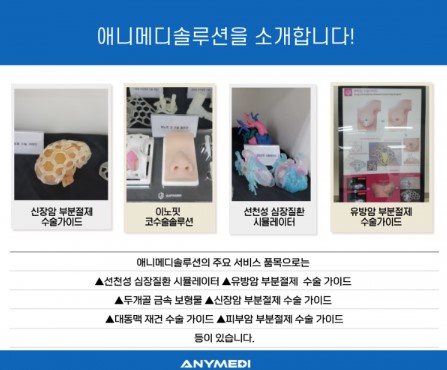
The words of Lee Jung-woo, a researcher in the production team at the Animedi Solution Product Development Center, were filled with pride. Based on thousands of cases of customized medical device clinical application know-how, currently, Animedi Solution is providing a global platform service on 3D modeling automation by using deep learning technology. The primary service items we are producing include customized/optimized surgical guides for patients in risk and high-difficulty surgical cases:▲Congenital heart disease simulator ▲Breast cancer partial resection surgery guide ▲Skull metal implant ▲Kidney cancer partial resection surgery guide ▲Aortic reconstructive surgery guide ▲Skin cancer partial resection surgery guide, etc.
The most impressive factor was the 'concentration' of the employees. Because most medical devices using 3D printing are custom-made, they require a precise and sophisticated quality control process. Therefore, each step must be thoroughly examined and verified for quality assurance.
In particular, since the surgical guide using 3D printing is based on the patient's image information (CT), no error is allowed. First, the medical staff analyzes the patient's image information (CT). After that, AniMedi solution implements 3D modeling based on the image, lessens the error rate with the medical staff, and then starts production. For this reason, it takes some time to manufacture a surgical simulator using 3D printing.
Researcher Jeong-Woo Lee said, "Since the simulator is manufactured in actual organ size based on patient CT data, there should be no error." "Many people assume that it takes a lot of time to manufacture a medical device using 3D printing, but in fact, it only takes three to four days," he explained.
■ 3D printing, today's despair into tomorrow's hope
3D printing can be reminiscent of a magical machine that instantly creates everything. However, this was not the case with the actual 3D printing production process. Have you ever seen the process of artisans refining jewelry? The craftsmanship looks very noble even to those who do not know anything about the jewelry. 3D printing production is in the same context in terms of crafting life.
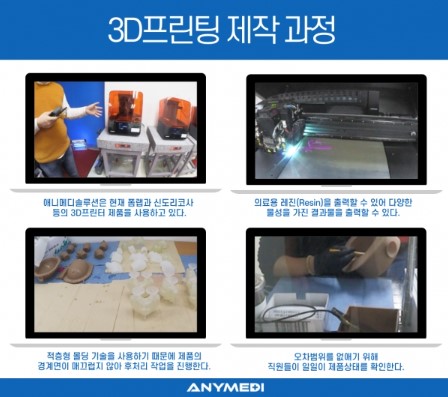
Animedi Solution is currently utilizing 3D printer products such as FormLab and Sindorico. These products have the advantage of being capable of biocompatibility applications. In particular, it is possible to print medical resin to print products with various physical properties. Therefore, it improves the surgical success rate by using a resin suitable for each organ in the body and printing a structure similar to living tissue.
But it doesn't end here. The most significant task remains for them: a 'post-processing' operation. The product interface is not smooth because 3D printing uses additive molding technology. Some people might consider, 'Isn't it okay to just use it?' but are wrong.
To intuitively show the patient's condition to the medical staff, it must be manufactured and assembled. Therefore, Anymedi Solution manufactures each organ and blood vessel distinctly. Therefore, if the interface is not smooth enough, the margin of error is bound to increase when each part is assembled.
In addition, each organ must be colored to distinguish from one another. In response, the researchers deliberately color the printouts. After that, the finished product is rechecked through a scanner to verify safety and error rate.
"Recently, as cutting-edge technologies such as 3D printing, artificial intelligence, and virtual reality have been applied to medical care, 'customized treatment' has become feasible," stated researcher Lee Jung-woo. "Among them, 3D printing produces customized products for patients ranging from rare cancers to complex fractures, long-term problems are predictable. I believe the future of K-Medical is bright to that extent," he declared.
![[Card News] Better Together Seoul Culture & Wellness Festival...See you on October 9 at DDP Oullim Square!](/news-images/85341c44f72401a7415c4da5ca3242f3434fe2a10935287f5b87d7acbd88ad87-480-v1.webp)