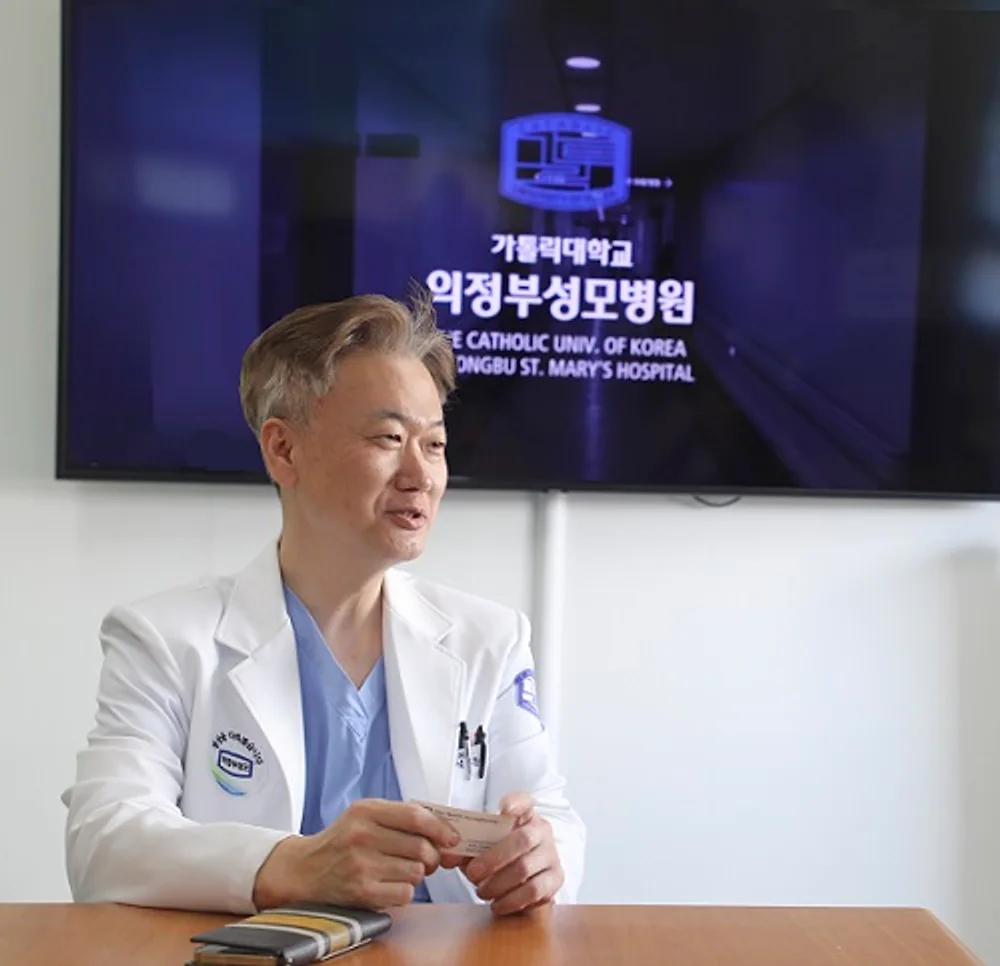
The knee joint plays a vital role in moving the legs, so if damaged, it can cause significant inconvenience in daily life. In particular, articular cartilage is difficult to recover and regenerate on its own, so when it is damaged, many people first consider artificial joint surgery. However, recently, with simple surgeries such as autologous stem cell therapy (hereafter referred to as the therapy), regeneration has become possible, which can improve the quality of life. I met with Professor Kim Seok Jung from the Department of Orthopedic Surgery at Catholic University Uijeongbu St. Mary's Hospital to learn more about this.
- What help does autologous stem cells provide in knee joint therapy?
The joint cartilage can be thought of as a consumable. Since few cells are inside the cartilage, it does not regenerate well once damaged. However, in this case, autologous stem cell therapy helps to effectively revive damaged joint cartilage. It mainly uses concentrated bone marrow cells, which contain not only stem cells involved in regeneration but also various growth factors.
Therefore, if you have pain in your knee and the cartilage is damaged, consider stem cell therapy. However, if arthritis has progressed significantly, the prognosis is generally inadequate. Therefore, depending on the extent of cartilage damage, knee arthritis is classified into four stages, and stem cell therapy is usually recommended for cases in stages 2-3.
- Where are autologous stem cells extracted from? Bio-kits' importance is emphasized in this process, so I am curious about the usage standards.
Autologous stem cells are mainly harvested from the patient's pelvis. They are extracted using a specially designed cannula and syringe, and it is essential to use a kit to effectively and sterilely concentrate the harvested bone marrow.
The concentrated bone marrow stem cells used in the therapy refer to the mononuclear cells concentrated and separated from the buffy coat layer, which is obtained by centrifuging the bone marrow aspirate. If the bone marrow aspirate is contaminated during the two rounds of centrifugation required for the therapy, there is a high likelihood of inflammation even if the treatment is successful.
Therefore a kit called TriCeLL Kit from a company called Rev-Med is used. This kit allows them to perform two rounds of centrifugation at once, reducing the risk of contamination in the solution during the concentration process.
- You are recognized for having performed the therapy early on. How many cases have you treated so far?
I have been performing stem cell therapy since working as a military doctor. While working in the Air Force and public hospitals, I met many patients with knee joint diseases in the Air Force. Therefore, after considering effective treatment methods, I successfully performed autologous stem cell therapy for the first time in the military. In 2001, this treatment was introduced in the National Defense Daily under the name 'Autologous Chondrocyte Implantation.'
After being discharged, I continued to research knee cartilage regeneration. In 2009, I developed the "Endoscopic Stem Cell Cartilage Regeneration Surgery," performed entirely under endoscopy and is still in use today. I perform all procedures using only 3-4 small incisions of approximately 1cm each, without any additional significant incisions to the knee. This approach helps patients to recover and rehabilitate quickly.
- What are the advantages and disadvantages of stem cell therapy compared to other treatments for knee joint disease?
The most significant advantage is its lower risk of side effects. If using other people's cells or commercialized cells, the diseases or abnormalities they carry may directly affect the patient, leading to the possibility of infection or abnormality occurrence.
However, using autologous stem cells eliminates this risk because the cells come from the patient's own body. Additionally, the process of concentrating the patient's own tissue can naturally promote regeneration by obtaining high concentrations of cells and growth factors. The main disadvantage includes that each patient's tissue and cells are unique, making it difficult to generalize the results.
- What are the possible side effects of the treatment, and how likely are they to occur?
Since the treatment uses the patient's own tissues, there are fewer side effects, such as immune reactions, than in previous stem cell therapies. Therefore, so far, no significant side effects have been reported. However, the extent of cartilage damage and the age of the patient can affect the treatment results. In other words, the success rate of autologous stem cell therapy is low in end-stage arthritis with extensive damage. And as aging progresses, stem cell activity decreases, making it challenging to obtain sufficient stem cells. Therefore, age restrictions limit stem cell use from autologous bone marrow concentrate to individuals between 15 and 50 years old in South Korea.
- What are the research achievements and future plans related to stem cell therapy?
So far, I have published several primary research papers and clinical research papers related to cartilage regeneration and arthritis treatment. In animal experiments and laboratory studies, I confirmed excellent results in cartilage regeneration and experienced an improvement in arthritis symptoms and well-maintained improvement in clinical studies. In addition, I have conducted basic and clinical research on bone regeneration as well and applied the therapy to patients with avascular necrosis of the femoral head, achieving relatively successful outcomes.
Recently, I was selected for a new research project supported by the Korea Research Foundation. The research topic is "Discovery of dual-targeting therapy for osteoarthritis through Kindlin-2-mediated mitochondrial-STAT3 induction for chondrocyte regeneration and anti-inflammatory effects." I am approaching the development of osteoarthritis treatments from a new perspective and researching essential points related to treatment. As osteoarthritis is a musculoskeletal disease that must be overcome, especially in an aging society, the goal is to lay the foundation for developing effective therapies through three years of government support.
![[Card News] Better Together Seoul Culture & Wellness Festival...See you on October 9 at DDP Oullim Square!](/news-images/85341c44f72401a7415c4da5ca3242f3434fe2a10935287f5b87d7acbd88ad87-480-v1.webp)