

A Korean research team has developed a process for early lung cancer diagnosis with only a blood test. It can be performed without the inconvenience of tissue biopsy (a test method for diagnosing cancer by collecting tissue from a patient).
Professor Sung-Hye Hong's research team in the Department of Biosystems and Medicine at Korea University announced that they had revealed a 'GCC2 biomarker' to diagnose lung cancer through blood tests.
Lung cancer has the highest frequency and mortality worldwide, and the survival rate five years after diagnosis is not high. Early diagnosis is so critical to improving the survival rate of lung cancer.
However, chest X-rays, low-dose computed tomography, and positron emission tomography suggested in the lung cancer screening guidelines cost a lot. Moreover, those screening tests are challenging to repeat because of the risk of radiation exposure. Accordingly, there is an urgent need for an early diagnosis with low-risk blood and biomarkers.
Under these circumstances, the GCC2 biomarker discovered by this research team presented an outstanding performance in early lung cancer diagnosis. Above all, identifying GCC2+ exosomes obtained from peripheral blood opens the possibility of early diagnosis of lung cancer even in asymptomatic people with only a basic blood test.
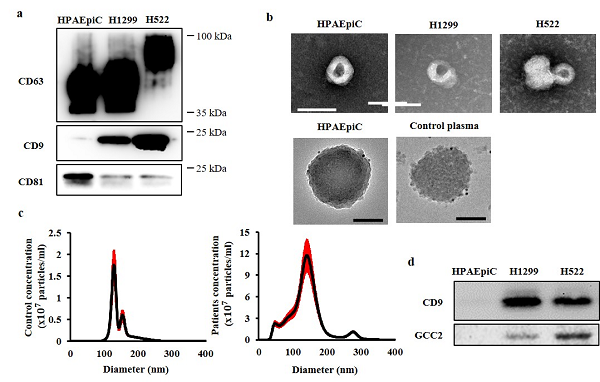
Exosomes, which are tiny vesicles secreted by cells, contain various cellular materials. The research team discovered a new biomarker, GCC2 protein, which can differentiate the exosomes secreted by normal and non-small cell lung cancer cells.
GCC2 protein, a membrane protein in the intracellular Golgi apparatus (Gogi Apparatus), plays an intracellular transport role. The research team recognized the marker only in lung cancer cell lines through proteomic analysis, explaining a tendency to increase with lung cancer stage progression. In other words, it served great in diagnosing lung cancer by presenting a significantly high expression increase in the early stage of lung cancer.
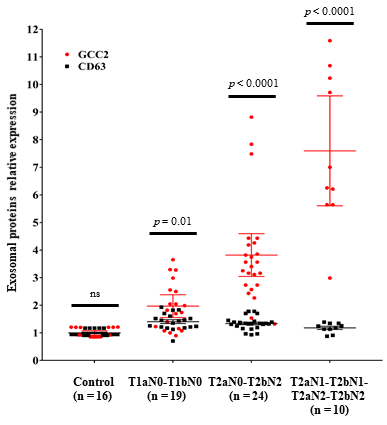
The research team found that the expression level of GCC2 protein in exosomes secreted from plasma of patients with early-stage lung cancer (stage 1) was significantly higher than that of healthy controls. The diagnostic sensitivity and specificity of exosome GCC2 checked through a receiver operating characteristic curve (ROC curve) revealed that sensitivity was 90% and specificity was 75%.
The research team explained, "The ROC value of 0.844 means that the GCC2 protein can effectively differentiate if exosomes were secreted from normal or lung cancer cells. Thus it demonstrates that GCC2 is a biomarker that can diagnose non-small cell lung cancer at an early stage."
Professor Sung-Hye Hong of Korea University, who is in charge of the research, said, “Early diagnosis is essential to increase the survival rate of lung cancer patients, but methods such as tissue biopsy put a lot of burden on the patient.” She continued, "The blood test method developed this time allows safe and early diagnosis of lung cancer without the inconvenience of tissue biopsy to enhance the survival rate."
Meanwhile, this study carried out with the support of Korea University's research-oriented hospital project and biomedical technology development project was published in the online edition of 'cancers,' an excellent academic journal, on October 31 (Korea time) under the title of GCC2 as a New Early Diagnostic Biomarker for Non-Small Cell Lung Cancer.
![[Card News] Better Together Seoul Culture & Wellness Festival...See you on October 9 at DDP Oullim Square!](/news-images/85341c44f72401a7415c4da5ca3242f3434fe2a10935287f5b87d7acbd88ad87-480-v1.webp)